
Artificial intelligence jobs are on the rise as it is being integrated into more and more industries. Artificial intelligence (AI) has emerged as a driving force behind numerous technological advancements. AI jobs encompass a wide range of roles that involve the development, implementation, and management of AI technologies. From data scientists and machine learning engineers to AI researchers and business strategists, these professionals play a crucial role in leveraging AI to drive innovation and solve complex problems across different sectors.
AI careers offer diverse opportunities for individuals with a passion for technology and innovation. Whether you’re interested in data analysis, algorithm development, or strategic planning, there are various career paths to explore within the field of artificial intelligence. Specialized skills and qualifications are essential for success in AI careers, with a demand for professionals proficient in programming languages, statistical analysis, and machine learning algorithms.
AI job opportunities
With the continuous advancement and integration of AI technologies across various industries, organizations are recognizing the transformative potential of AI to drive innovation, improve efficiency, and gain a competitive edge in the global market. As a result, there has been a remarkable increase in the demand for AI professionals across a diverse range of sectors, ranging from healthcare and finance to retail, manufacturing, and technology
The demand for AI professionals has significantly increased across various sectors, with the top three sectors being IT (5.3% of all job postings), professional, scientific, and technical services (4.1%), and finance and insurance (3.3%).
Increasing Demand for AI Jobs
Rapid Technological Advancements
The continuous advancement and integration of AI technologies across industries have led to a growing demand for professionals with expertise in artificial intelligence.
Recognition of AI’s Potential
Organizations recognize the potential of AI to drive innovation, improve efficiency, and gain a competitive edge in today’s digital economy, contributing to the increased need for AI talent.
Diverse Range of Industries Seeking AI Talent
Healthcare
AI professionals are sought after for developing AI-powered medical diagnostics, personalized treatment plans, and predictive analytics for patient care.
Finance
In finance, AI is used for algorithmic trading, fraud detection, risk assessment, and customer service, creating demand for AI jobs in the industry.
Retail
Retailers utilize AI for customer segmentation, recommendation systems, inventory management, and supply chain optimization, driving the need for AI expertise.
Manufacturing
AI is employed in manufacturing for predictive maintenance, quality control, process optimization, and automation, leading to demand for AI professionals in the sector.
Technology
Tech companies leverage AI for product development, software engineering, research, and innovation, fueling the demand for AI talent in the technology industry.
Significant Growth in AI Job Postings
Job Market Trends
AI jobs have experienced a substantial increase in recent years, reflecting the growing importance of AI technologies in the market.
Job Titles
Companies are actively recruiting AI professionals for various roles, including data scientists, machine learning engineers, AI researchers, AI product managers, and AI consultants.
Opportunities for Entry-Level to Senior Leadership Roles
Entry-Level Positions
Entry-level opportunities in AI may include roles such as AI research assistants, data analysts, junior machine learning engineers, and AI software developers.
Mid-Level Positions
Mid-level positions offer opportunities for career advancement, including roles such as AI engineers, AI consultants, and AI project managers.
Senior Leadership Roles
Seasoned professionals can pursue senior leadership roles in AI, such as AI team leads, AI directors, and AI executives, responsible for overseeing strategic AI initiatives within organizations.
Opportunities for Career Growth and Advancement
Specialization
AI professionals have opportunities to specialize in various subfields of AI, such as computer vision, natural language processing, robotics, autonomous systems, and AI ethics.
Continuous Learning
The dynamic nature of the AI field necessitates continuous learning and skill development, with opportunities for professionals to acquire new skills and stay abreast of the latest advancements in AI technology.
Career Advancement
AI professionals can advance their careers through training, certifications, advanced degrees, and hands-on experience, positioning themselves for leadership roles and higher levels of responsibility within the field.
Thus, AI job opportunities are diverse and abundant, spanning across industries and experience levels. With the increasing demand for AI professionals and the evolving nature of the field, individuals looking to pursue a career in artificial intelligence have ample opportunities for growth, advancement, and impact in the dynamic and rapidly evolving world of AI.
Artificial Intelligence Career Paths
Artificial intelligence offers a multitude of career paths for aspiring professionals. Whether you’re interested in pursuing a career in research and development, data science, or AI consulting, there are numerous pathways to explore within the field. Educational programs and certifications in AI-related disciplines can provide valuable skills and knowledge to help individuals succeed in their chosen career path.
Skills and Qualifications for AI Jobs
Key skills and qualifications required for AI jobs include proficiency in programming languages such as Python, strong analytical and problem-solving abilities, and a deep understanding of machine learning algorithms and techniques. Continuous learning and upskilling are essential for staying abreast of the latest developments in AI technology and maintaining a competitive edge in the job market.
The demand for AI jobs is evident across various industries, including healthcare, finance, retail, and manufacturing. Organizations are increasingly leveraging AI to streamline operations, enhance customer experiences, and drive business growth. As AI continues to transform industries, the demand for skilled professionals with expertise in artificial intelligence is expected to grow exponentially in the coming years.
Challenges and Opportunities in the AI Job Market
While the demand for AI jobs is high, challenges such as the skills gap and talent shortage pose significant hurdles for organizations seeking to hire AI professionals. Diversity and inclusion are also important considerations in the AI job market, with efforts underway to promote diversity and ensure equal opportunities for all individuals interested in pursuing careers in artificial intelligence.
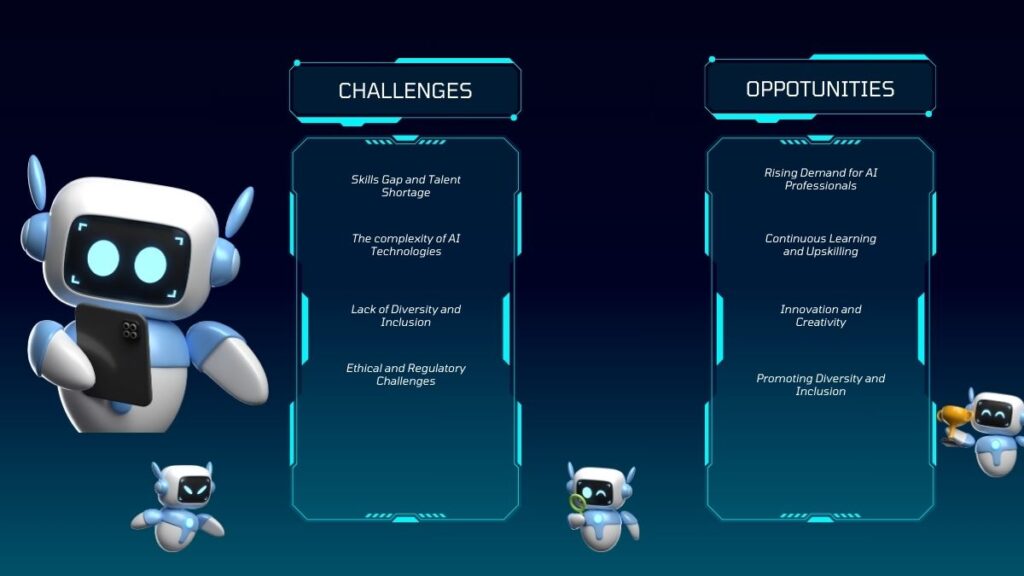
Challenges
- Skills Gap and Talent Shortage
- Despite the high demand for AI professionals, there is a significant shortage of talent with the necessary skills and expertise in artificial intelligence.
- The rapid pace of technological advancements often outpaces the rate at which individuals can acquire new skills, leading to a persistent skills gap in the job market.
- The complexity of AI Technologies
- AI technologies are highly complex and require specialized knowledge in areas such as machine learning, natural language processing, and computer vision.
- Organizations struggle to find candidates with the requisite technical skills and experience to effectively implement and manage AI initiatives.
- Lack of Diversity and Inclusion:
- The AI workforce suffers from a lack of diversity, with women and underrepresented minorities often underrepresented in AI-related roles.
- Limited diversity in the workforce can lead to biases in AI algorithms and technologies, exacerbating existing social inequalities and discrimination.
- Ethical and Regulatory Challenges
- The rapid proliferation of AI technologies raises ethical concerns related to privacy, data security, and algorithmic bias.
- Regulatory frameworks governing the use of AI in various industries are still evolving, posing challenges for organizations seeking to navigate legal and ethical considerations.
Opportunities
- Rising Demand for AI Professionals
- The increasing adoption of AI technologies across industries has created a growing demand for skilled professionals with expertise in artificial intelligence.
- AI professionals have access to a wide range of career opportunities, from data science and machine learning engineering to AI research and development.
- Continuous Learning and Upskilling
- The dynamic nature of the AI job market presents opportunities for individuals to continuously learn and upskill to stay competitive.
- Online courses, boot camps, and certification programs offer flexible learning options for professionals looking to acquire new skills and advance their careers in AI.
- Innovation and Creativity
- AI professionals have the opportunity to drive innovation and creativity by developing groundbreaking AI applications and solutions.
- From developing AI-powered healthcare diagnostics to optimizing supply chain operations, AI professionals play a crucial role in shaping the future of technology and business.
- Promoting Diversity and Inclusion
- Organizations are increasingly recognizing the importance of diversity and inclusion in the AI workforce and are implementing initiatives to promote greater diversity.
- Efforts to increase diversity in the AI workforce can lead to more inclusive and equitable AI technologies that benefit society as a whole.
So, the AI job market presents challenges such as skills gaps and diversity issues, it also offers significant opportunities for professionals to contribute to innovative projects and drive positive change through the responsible development and deployment of AI technologies. By addressing these challenges and seizing opportunities, organizations and individuals can work together to build a more diverse, inclusive, and ethical AI workforce.
Conclusion
In conclusion, the future of AI jobs is undoubtedly promising, with a plethora of opportunities across industries. Despite challenges like the skills gap and diversity issues, the increasing demand for AI professionals showcases the vital role they play in driving innovation and addressing complex societal challenges. By prioritizing continuous learning, promoting diversity, and embracing ethical practices, both organizations and individuals can harness the transformative power of AI to create a more inclusive, equitable, and prosperous future. As we navigate the dynamic landscape of AI, collaboration and commitment to responsible AI development will be key to realizing its full potential for the betterment of society.